Tag: shift handoff

  • When You’re Right but Can’t Send the Email You Want to Send

    When You’re Right but Can’t Send the Email You Want to Send

    Maintenance ghosted Forklift 4’s hydraulic leak for four days. You’re tired, you’re frustrated, and you need it fixed today, not next week.

    The email you want to send would probably get you a meeting with HR. The email that gets the forklift fixed looks completely different. Most people never learn to write the second one under pressure.

    Here’s how to turn the first draft into the second one without losing the part that makes it effective: the fact that you’re right.

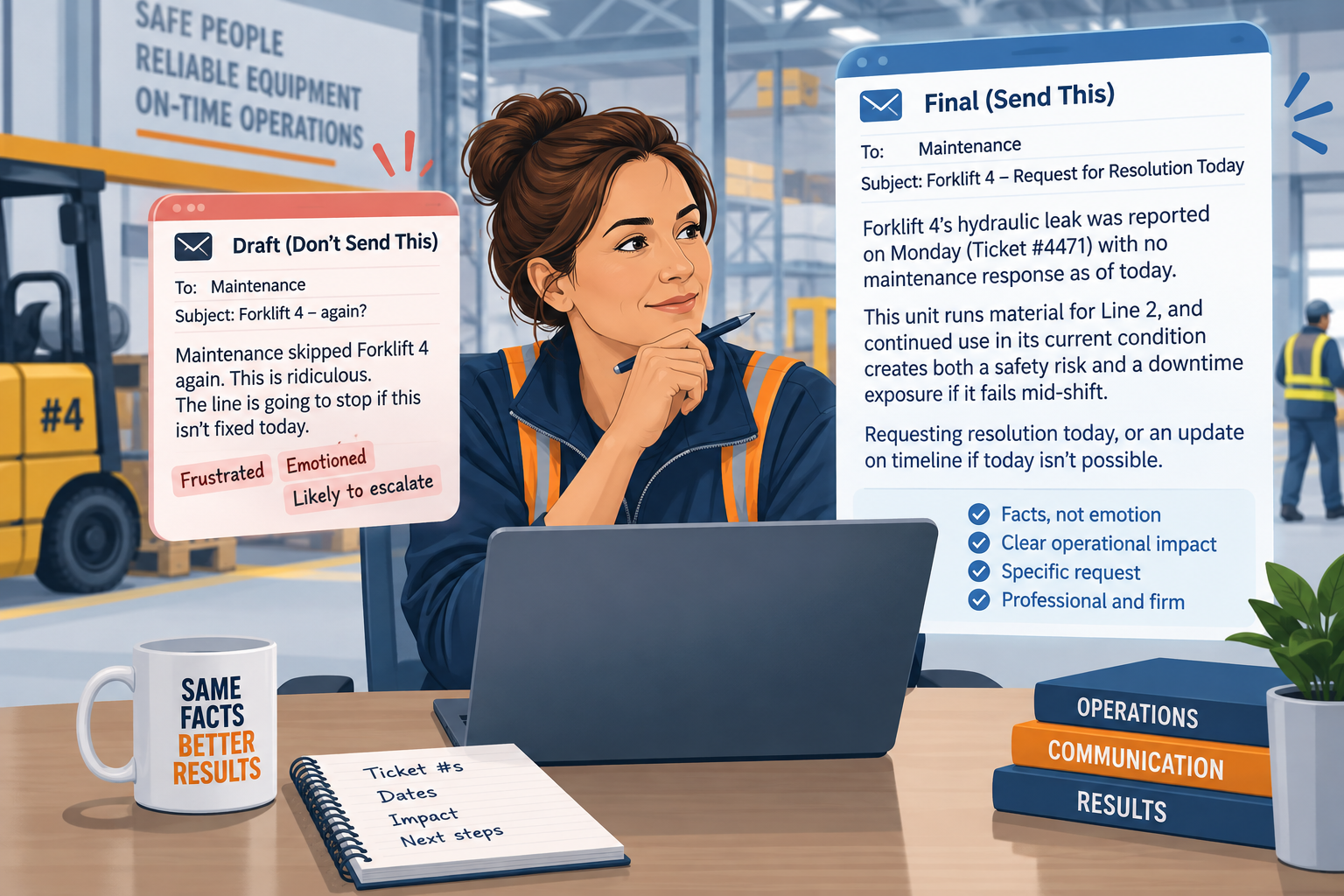
    Card 1: The Raw Frustration Draft

    This is the version that exists in your head before anything gets typed.

    “Maintenance skipped Forklift 4 again. This is ridiculous. The line is going to stop if this isn’t fixed today.”

    Write this version first if it helps. Getting it out of your system matters.

    Just don’t send it. Don’t skip straight past it either, because the frustration in it is where the real information is buried.

    Card 2: The Calibrated AI Prompt

    Feed the raw version to Claude or ChatGPT with instructions like this:

    “Rewrite this with a firm, objective operational tone. Cite the safety risk, the downtime exposure, and the ticket history. Remove the emotion but keep the urgency. Don’t soften it into something that sounds optional.”

    That last line matters. Most rewrite requests accidentally sand a message down until it reads as a gentle suggestion instead of a real problem. This instruction stops that from happening.

    Card 3: The Final Communication

    What comes back reads like this:

    “Forklift 4’s hydraulic leak was reported on Monday (Ticket #4471) with no maintenance response as of today. This unit runs material for Line 2, and continued use in its current condition creates both a safety risk and a downtime exposure if it fails mid-shift. Requesting resolution today, or an update on timeline if today isn’t possible.”

    Same facts. Same urgency. Zero language anyone could screenshot and use against you later.

    Why This Isn’t Just “Being Nicer”

    There’s a real distinction in workplace communication research between assertive and aggressive tone. It’s worth understanding rather than just imitating.

    One breakdown of the difference lays it out cleanly: aggressive communication disregards the other person’s position entirely, while assertive communication states the facts and the need plainly, without either attacking or softening into a suggestion.

    The rewritten forklift email is the assertive version, not a watered-down one. It says exactly what’s wrong and exactly what needs to happen. It just doesn’t hand anyone a reason to focus on your tone instead of the actual problem.

    The Accountability Rule

    Every version of this email works better with two things attached: a timestamp and a ticket number.

    “Maintenance is slow” is an opinion. Opinions are easy to dismiss.

    “Reported Monday, Ticket #4471, no response as of Thursday” is a fact. Facts are a lot harder to wave off in a follow-up meeting.

    Keep a running note of when you reported something and what reference number it got. That habit turns every future email like this into a thirty-second rewrite instead of a fresh fight.

    Why the Rewrite Works Better Than the Original

    The raw version feels satisfying to send. It rarely gets the forklift fixed any faster.

    It tends to make the next request from you a little easier to dismiss too. A heated email is easy to file under “someone’s having a bad day” instead of “real problem, needs action.”

    The calibrated version does something the raw one can’t. It puts the reader in a position where ignoring it looks bad on paper, not just uncomfortable in a conversation.

    That’s the actual goal. Not sounding nicer. Getting the fix.

    A Second Version, Different Department

    Maintenance isn’t the only source of this kind of friction. The night shift leaves a line running out of spec and doesn’t flag it, and the day shift inherits the problem three hours in.

    Raw draft: “Night shift didn’t say anything about Line 3 running hot again. Found out the hard way an hour into my shift.”

    Calibrated: “Line 3 was running above the acceptable temperature range at the start of day shift, with no note in the handoff log. This created a quality risk on the first hour of production before it was caught. Requesting that temperature checks get added to the standard handoff checklist going forward.”

    Same shape, different department. Facts, risk, a specific ask, nothing anyone can dismiss as tone.

    What Not to Let the Rewrite Do

    A calibrated tone isn’t the same as a vague one. If the rewrite starts using phrases like “when convenient” or “at your earliest opportunity,” that’s the tool softening urgency it was told to keep.

    Push back on the draft the same way you’d push back on a person. “Make it more direct” or “add the deadline back in” gets a second pass that fixes it fast.

    A Prompt You Can Reuse on Any Cross-Shift Friction

    The same shape works whether it’s maintenance, another shift, or a different department entirely:

    “Rewrite this with a firm, objective tone. Cite the specific risk or cost of not acting, reference any ticket or timestamp I’ve provided, and keep the urgency without the emotion.”

    Swap in your own raw draft and your own specifics. The structure holds regardless of which department is on the other end.

    When to Stop Emailing and Start Walking Over

    Worth saying plainly: a well-written email is not a substitute for an actual conversation once something’s been ignored twice.

    If Ticket #4471 gets a second silence, the next move is a phone call or a walk to the maintenance shop. Not a third, even better-worded email.

    The template above earns you a fair first shot at resolution through the normal channel. It’s not meant to replace the moment when you decide the normal channel isn’t working anymore.

    The Floor Manager’s $20 AI Stack covers which tool handles this kind of writing best if you’re still deciding. Shift Notes to Shift Handoff: We Tested 3 AIs on the Same Messy Floor Notes picks up the same theme from a different angle, turning a full shift’s worth of chaos into something the next person can use.

    Comment below with the email you really wanted to send this week, and the one you sent instead.

  • Shift Notes to Shift Handoff: We Tested 3 AIs on the Same Messy Floor Notes

    Shift Notes to Shift Handoff: We Tested 3 AIs on the Same Messy Floor Notes

    A good handoff note has one job. Make sure the real risk gets seen before the small stuff does.

    Most don’t. A downtime event and a broken ice machine end up sitting in the same paragraph, same weight, same font. The next shift lead sorts out which one really matters standing up, usually with someone already asking them a question before they’ve finished reading.

    So we ran an experiment. Same messy notes. Same exact prompt. Three different AI tools. And one uninvited fourth guest we’ll get around to that later.

    The question wasn’t whether they could clean up the grammar. Any of them can do that in their sleep. The real question was whether they’d know what mattered.

    The Note We Fed Every Tool

    This is the raw version, typed the way a tired shift lead really types, half-punctuated and running downhill:

    Line 2 down 40 min around 10am, changeover took longer than usual, think it was the die swap on station 3, Marcus was working it. Forklift 4 still has the hydraulic leak, maintenance said Tuesday but never showed. Ran short on the 6mm fasteners again, used the backup bin, only maybe 200 left in it now. New temp on line 1 afternoon, did fine but slow, needs another day of shadowing before solo. Quality flagged 3 units off the line 2 run after the changeover, pulled and set aside by the press, not scrapped yet, waiting on Denise to look at them tomorrow. Everything else ran normal. Oh and the break room ice machine is out again.

    The prompt isn’t new either. It’s pulled directly from a piece we already published on decoding exactly this kind of inherited note. No reason to make you go dig it up, here it is in full, ready to paste into whatever you’re using tonight:

    You are an operations management assistant helping me process a shift handoff note. I am giving you the raw start-of-shift note from the previous shift lead, written by hand or dictated in a rush. Treat every line as something that might be incomplete.

    Structure your output using the exact sections below:

    1. WHAT HAPPENED

    – A plain-language summary of what actually occurred last shift, in the order it happened if the note makes that clear.

    2. STILL OPEN

    – Anything unresolved that needs my attention or a decision from me today.

    – For each item, note whether it’s urgent (needs action in the first hour) or can wait.

    3. TOP PRIORITY

    – The single most urgent item on this list, and one sentence on why it outranks everything else.

    4. WHO I NEED TO FOLLOW UP WITH

    – Based on what’s in this note, list anyone I likely need to contact today: maintenance, quality, the site leader, HR, a specific operator, anyone named or implied.

    – For each person, say what they need from me and how urgent that follow-up is.

    – Flag anything that looks like it needs to go to Quality or EHS specifically. Those two categories don’t wait.

    5. UNCLEAR OR MISSING

    – Anything in the note that’s ambiguous, contradicts standard work, or is missing information you’d expect to see (headcount, safety incidents, quality holds).

    – Do not guess at anything not stated in the note. Flag it as missing instead.

    Same prompt, same notes, word for word, into ChatGPT, Claude, and Gemini. Free tier on all three, memory cleared first, so nobody walked in with a head start.

    The Verdicts

    ChatGPT

    ●        Top Priority: the forklift’s hydraulic leak, reasoned as outranking the quality hold because the note never confirms whether the leak was tagged out or is still in use.

    ●        Gave the ice machine something none of the other tools bothered with the benefit of the doubt. Filed under “can wait,” but with a real condition attached, unless there’s a sanitation or heat-stress angle nobody mentioned.

    ●        Stayed disciplined on the die swap, calling it “not confirmed” twice instead of letting a guess quietly become a fact.

    ●        Didn’t ask a single clarifying question. Just went straight to work.

    Claude

    ●        Top Priority: also the forklift, same safety-first logic as ChatGPT.

    ●        Did something almost embarrassingly simple that the other two skipped entirely: it filled in every box the prompt asked for, site leader included. Nobody else even mentioned that category existed.

    ●        Caught a genuine distinction nobody else made. Denise’s review is scheduled for tomorrow, but confirming the units’ physical status and paperwork shouldn’t wait that long. Claude split those into two different clocks instead of treating them as one task.

    ●        The only tool willing to say “urgent leaning” out loud instead of forcing the fastener count into a clean yes or no.

    ●        Went further than repair status and questioned whether the leak had ever been formally logged as a safety hazard at all, or just quietly sat as a maintenance ticket nobody escalated.

    Gemini

    ●        Top Priority: the forklift too, and the most procedurally fluent of the three. It reached for real lockout and tag-out language, not a vague “someone should look at this.”

    ●        Most literal about the flagging instruction, tagging entries directly with [FLAG: EHS] and [FLAG: QUALITY] instead of burying urgency in a sentence.

    ●        Also the one that broke the rule. It reasoned that if the die swap caused the delay, current Line 2 production might also be non-conforming, connecting two dots the notes never touched. That’s the exact mistake the source prompt was written to prevent. Gemini’s the one that made it.

    ●        Caught something sharp nobody else did: “set aside by the press” isn’t the same thing as a documented hold. A press ledge is not a quarantine bin, no matter how urgent the tone around it sounds.

    Where They Agreed, Where They Split

    All three landed on the same Top Priority. Three companies, three completely different models, and every one of them decided an unresolved safety risk beats a contained quality hold, even one sitting closer to the loading dock. That’s not a small thing to agree on.

    Where they earned their keep was underneath that headline call. Claude was the only one that followed every instruction in the prompt to the letter. Gemini was the only one that invented a connection nobody asked it to make.

    Read only the top line of each response and you’d think all three did the same job. Read the whole thing. You find out which one you’d really trust with a decision that matters.

    We Also Ran It Through Grok, Out of Curiosity

    Full disclosure: not a tool I reach for often. My husband swears by it. Tells me not giving it a fair shot for months. Challenge accepted.

    Grok broke from the pack entirely. Its Top Priority was the quality hold, reasoned as needing immediate attention to protect product integrity and keep good material from mixing with bad. It also said flatly that nothing in the note pointed to an EHS incident, the opposite read from every other tool in the test.

    Not necessarily wrong. A hold sitting close to shipping is a real argument, not a lazy one. But it’s the one tool in the whole lineup that walked away from consensus on the single call that mattered most, which is worth knowing if it’s the one already living in your phone.

    How to Run This Yourself

    Pull a real handoff from your own floor, one with at least one safety-adjacent item and one genuine non-issue tangled up together.

    Clear memory and any saved custom instructions first, in every tool you’re testing. That’s the step people skip. It’s also the one that quietly rigs the result toward whichever tool already knows your plant.

    Paste the identical prompt above and your own notes into each one, back-to-back, same sitting. Read Top Priority first, before anything else. That single line tells you more about how a tool reasons than the rest of the output combined.

    The Actual Takeaway

    Run this on your own notes before you trust any one tool’s version of “what matters most” without a second opinion standing next to it. Free tier, five minutes, the exact prompt is sitting above, copy it and go.

    If two tools agree and a third doesn’t, that disagreement is the useful part. It’s pointing directly at the judgment call that’s genuinely hard. The kind of call that turns into a real decision nobody remembers making unless someone catches it first.

    The Floor Manager’s $20 AI Stack is worth a read if you haven’t settled on which of these is worth paying for yet. We ran this same test live on camera too, over on The Constraint Files, if you’d rather watch the answers land in real time than read about them after the fact.

    Comment below with which tool you’d trust to run your next real handoff, and which one just lost your trust after reading this.